
Would I be letting my cat down if I didn't stay in the room for her euthanasia?

Dear s.e.,
I’ve had three cats euthanized. I didn't go in with my first, Kiki. Morgan the Most Handsome Cat Ever was the second one. I was in there and instead of sadness it was more of a relief that his suffering was over.
The third cat, Trixie the Wonder Kitty, was the most difficult. It was 2 1/2 years ago and I was in the room when the doc did it. I was able to (I think) ease the process for my baby girl. The doc said ‘she has passed’ and it was maybe the worst thing I’ve ever experienced. I didn’t even want to get another cat because I didn’t want to go through that again. I ended up getting a new kitty, Trillian, and she is such a sweet kitty. 😻
Here’s my question:
I know it’s better for the animal when their closest human is with them. But for me, I will never ever forget that feeling when the doc said what she said. I can’t even write what she said without crying. Almost three years later and if I talk to someone about her I invariably end up teary eyed. I swear it almost seems like PTSD because of the way I’ve felt since. I honestly don’t know that I could go through with that again. In the back of my mind I’m almost hoping that I pass before her so I don’t have to go through with that again.
Is there another way, a different way to euthanize a cat without either feeling the guilt for not being in there for her when she passes, or feeling the extreme sadness being in there for her and having it be far more traumatic for me?
Just looking for a little advice for when that time comes. I know in my heart it’s the right thing to do, to be there for them, but my heart also got extremely shattered with Trixie.
Thank you for your help,
Randy, Cat Dad
Hey there, Randy,
I'm so sorry for your losses, and that you had such a bad experience with euthanizing Trixie—it sucks to have such a sour last memory. You clearly had a lot of love for Trixie and she occupied a really important role in your life. It sounds like your terrible last day still really eats at you and I can understand why you're so worried about what might happen with Trillian. That stress is a lot to have on your mind and I know how that fear can weigh on a person; please know that you are definitely not alone in having fear and anxiety around euthanasia.
I have a short answer to your question:
Yes, there is a third option for you, and that is to be present for the initial sedative, but to step out for the euthansia itself after your cat has gone to sleep. (For readers who aren't familiar, almost all companion animal euthansias are a two-step process. The first is a sedative injection so the pet falls deeply asleep, usually within a few minutes, and once the animal is fully unconscious, the vet will administer another medication.)
Vet clinics will always accommodate this option. It's not an uncommon request, and they're not going to judge you for it; they know euthanasia can be an intense and sometimes overwhelming experience. They want both you and your pet to have the best experience you possibly have under the circumstances.
You're not a failure or a bad person for making some choices to protect your heart.
The longer version:
Being present for euthanasia is not for everyone, for a number of reasons. It's certainly helpful for animals to have a familiar person with them at end of life, and some people also find the experience to be meaningful and important for them, but everyone is different, and you don't need to justify the way that you feel. Forcing yourself to do something that makes you feel awful certainly won't make for a calm or fulfilling experience for anyone and can instead create a feedback loop where you're upset at yourself for feeling upset, and it makes a very bad day even worse.
If just thinking about being present at euthanasia is overshadowing your life like this, give your current and future selves a break. Know that it's okay to decide how much you want to be involved, and that you're not a failure or a bad person for making some choices to protect your heart. It's also okay to change your mind about being present, or not, at any step of the process—and there are a lot of things that you can do, and work with your vet on, to make this experience as good as it possibly can be.
If your concern is just being present in the room for any part of the appointment, even being there for just the sedative might feel like too much—some people simply emphatically do not want to be there for any part of this process. And that is okay: It is, again, not an uncommon request, and you can be assured that the vet staff will treat your cat with care, love, and respect to make sure she's surrounded by kind people and affection even if you can't be there.
My book on mourning, grief, and loss in our capitalist hellscape comes out next week! Order All My Dead Cats and Other Losses from one of the independent bookstores partnering with me—The Stacks in Savannah, GA, or Book People in Austin, TX—to get stickers, a bookplate, and a cute pin.
But I do think you might find some peace and balance in this hybrid option. There are some additional things you might want to consider that could make this easier for you as well, especially when it comes to allaying your fears about the unknowns of a final vet appointment.
One is doing a home euthanasia so that you don't have to leave the house at all, and thus don't need to experience the drive and being at the clinic if that part of the experience is worrying you. Even at home, you can choose how involved you want to be, and your cat can be comfortable in a familiar environment, rather than stressed out at the vet. Home vets can also take more time to move at your pace and those who focus on euthanasia work have a lot of empathy and care for clients like you and the experience to support you.
I'm a big endorser of home euthanasia and some vets offer it as part of their services while others specialize in it—if you're curious, you can always call to get information and talk through what it might look like while you decide if it's for you. End-of-life practices, incidentally, also offer palliative care at home for terminally ill animals to make them more comfortable in their final days. This might be something that you're not into, which is a-okay, I just want to make sure you know it's an option, and that end-of-life care at home doesn't require you to be intimately involved for the entire process.
Another option is to ask if it's possible to do the initial sedation in your car. Lots of people (and pets) get anxious thinking about having to actually go into the clinic, sit in the lobby, and then go into an exam room. The vet (and possibly an assistant) can come out to you where you're parked, give her the sedative, leave you two to have some time together until she falls asleep, and then bring her in to the clinic for the second injection. In clinic settings where I've worked, this option has been really helpful for a lot of families, but people aren't always aware that it's available.
I'd also encourage you to try to schedule your appointment to fall either very early in the morning when the clinic is just opening, or at the end of the day. Some clinics by default pick these times for euthanasia; they're quieter and less overstimulating, and make for a calmer experience for everyone. Having a mostly empty clinic also lets you do what you need to do without stressing out about what other people might do or think, whether you decide to stay in the room or not, to wait until you hear from the vet or leave right away, or to just sit in the lobby or the parking lot for a while to gather your thoughts. (Also, if the clinic is empty, initial sedation in the lobby could be available too if doing it in your car isn't an option for you or the clinic.)
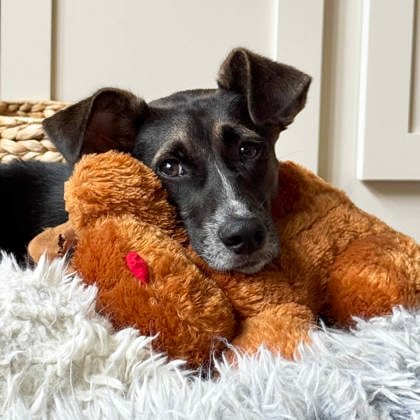
Dee Dee is a nine-month-old Shepherd/Catahoula mix currenly being fostered through the Atlanta Humane Society. Her fosters say she's "affectionate, active, and clever...a sweet, smart, and athletic girl who loves cuddling up for pets and naps with her people." At nine months she's already learning tricks and getting the hang of food puzzles, so if you're on the lookout for an active and super-smart dog to share your life with, she might be the one for you. If you have a Pet of the Week nomination, reach out to POTW at allmydeadcats.com.
In all cases, talk through what you'd like ahead of time with your veterinarian and their staff so everyone is on the same page about the plan and what's happening. You can ask as many questions as you need to about what to expect. They may have additional options or suggestions and they can walk you through what all of those are. Sometimes the scariest part is the unknown, not knowing how to handle yourself, or fearing that someone is going to do or say something before you're ready, so being really clear about your expectations and what you want is going to be helpful for everyone.
I also hope you have one or more good humans in your life that you can talk to about some of this as well. At very least, a friend should be able to give you a ride to the vet, drop off a meal, or offer other assistance to make the day easier for you. I know that not everyone has committed cat people to help out like this, and if you don't have a friendship like that yet, take this as your opportunity to get involved at the shelter or another community organization that brings cat people together.
If you're feeling fear and anxiety that's interfering with your relationship with Trillian or really overwhelming you, you might want to check in with a grief therapist or someone who specializes in modalities like EMDR to help you process what happened with Trixie. This recommendation isn't because I think there's something wrong with you that needs to be fixed (I don't think either of those things), but rather because living and growing with grief is an ongoing and complicated process, and everyone needs and deserves some structured support sometimes. When you experience a traumatic loss, it can leave marks, and counseling can be important for working through your emotions, being kinder to yourself, and being prepared for whatever the future might bring.
I also want to say that I'm very proud of you for writing in. I know thinking about this is hard for you and it always feels vulnerable to put yourself out there. I'm sorry that thinking to the future is causing you such distress, but I also think that taking it on now is going to help you and Trillian have a great life together with less fear and worry at the end.
Tell your cat I said...
May you live a long, healthy, and active life, and may this problem lie in the very distant future.
Head on over to submit a question and find resources including pet loss hotlines, quality of life assessment tools, and information on financial assistance with veterinary costs.